Χαῖρε!
My name is
Sam McChesney
and I'm a PhD candidate in the Department of Political Science at Northwestern University.
I study ancient Greek political thought, critical theory, and hermeneutics.
You can contact me at samuelmcchesney2023@u.northestern.edu.
About Me
My primary areas of research are classical political thought, critical antiquities, ethics, and the work of Hannah Arendt. My dissertation, “Political Courage,” aims to rethink courage — traditionally a military and aristocratic virtue — from a democratic perspective, drawing on both classical Athenian and modern political thought.
I also draw extensively on hermeneutics and the philosophy of language, democratic theory, feminist theory, and the works of Thucydides, Plato, Hans-Georg Gadamer, and Michel Foucault. My work lies at the intersection of historical, normative, and critical theory.
In addition, I have written and lectured on Renaissance/early modern political theory, including Montaigne, Machiavelli, and Hobbes.
My work has been published in The European Legacy and Labyrinth. I am currently an instructor for the course "Modernity and Its Discontents: Knowledge, Truth, and Politics" at Northwestern University. Beginning Fall 2026, I will be the Macricostas Endowed Teaching Fellow at Western Connecticut State University and an adjunct lecturer at Loyola University Chicago. I have previously instructed at the School of the Art Institute of Chicago and the University of Otago.
I hail from Aotearoa New Zealand, and have an MA and a BA(Hons) from Otago University. I've lived in Chicago since 2018, and when I'm not reading about ancient Athens you can find me cheering on the Chicago Sky.
You can find my full C.V. here.
Research
Dissertation: “Political Courage”
As Jason Scorza has argued, modern moral philosophy and normative political theorizing has displayed a deep “ambivalence” about courage.[i] A large number of figures influential within the liberal tradition—including Thomas Hobbes, Charles de Montesquieu, Immanuel Kant, the Duc de la Rochefoucauld, and Jeremy Bentham—have emphasized the harmful and destructive features of courage when this “ancient” virtue is placed in the service of misguided ends.[ii] For Scorza, “courage itself has very little normative content and contributes little (if anything) to the moral rectitude of an act.”[iii] For Amélie Oksenberg Rorty, courage “treats its domain, its objects, as External Others, to be endured, overcome or combated,” and thus an open-minded, pluralistic liberalism must always ensure that courage is “bounded, checked, and directed by other virtues.”[iv] And N. J. H. Dent suggests that the normative value of courage is bound up inextricably with contrasts between prowess and weakness, command and servility, and that “a certain sense that courage is the chief mark of the most estimable social class, the distinction of ‘nobility,’ lingers on.”[v]
This ambivalence, I suggest, reflects a view of courage in terms of what Hannah Arendt has called “strength”:
Strength unequivocally designates something in the singular, an individual entity; it is the property inherent in an object or person and belongs to its character, which may prove itself in relation to other things or persons, but is essentially independent of them. The strength of even the strongest individual can always be overpowered by the many, who often will combine for no other purpose than to ruin strength precisely because of its peculiar independence.[vi]
Both “martial” and “moral” courage signify the approval of human strength: in martial courage, this strength is appropriated by the political community and deployed against outsiders (Rorty’s “External Others”), while in moral courage, this strength is applied against the community in resistance to its demands. In both cases, strength carries a latent antagonism toward politics, understood as a domain of speech and action in concert with others. In martial courage, strength is made to operate within a state of exception in which antagonists are marked for death (the existence of rules of war merely limits without fundamentally altering this fact); and in moral courage, the relationship to oneself trumps the relation to others.[vii]
This dissertation argues that political life calls on distinct practices of courage that are irreducible to the strength-oriented terms of martial and moral courage. In particular, if politics is centrally concerned with what Arendt calls “power”—the emergent capacity of distinct and equal people to act in concert—then political courage involves a forbearance from the kind of arrogance and self-certainty that is the frequently accompanying vice of both martial and moral courage. Flexibility, listening, and openness to the unexpected—that is, the willingness to risk the boundaries of the self, or to shift one’s hermeneutic horizons (rather than taking these as the immovable grounds of one’s participation in political life)—are essential to the political practices of standing beside others in a relation of mutual support.[viii]
The dissertation focuses on fifth century BCE Athenian texts, in particular Thucydides’ History, Aristophanes’ Lysistrata, and Euripides’ Children of Herakles. Written during the century of Athens’ democratic apogee, these texts grapple in varying ways with the tensions between traditional courage (andreia) and democracy, understood as a joint “capacity to do things.”[ix] According to the democratic ideology, andreia, literally “manliness,” was the distinctive feature of the dēmos, the attribute that distinguished the exclusive citizen-group from its various disenfranchised “others.” And yet my chosen texts depict various acts of courage both by and alongside these others, acts that create openings for new mobilizations of power and that disrupt the ideological picture of democracy as the exclusive possession of the dēmos. Each of these texts, moreover, exhibits contrasting tendencies both to acknowledge the courageous acts of outsiders, and to suppress or circumscribe these acts in the name of the dēmos. In this way, the texts illustrate possible theorizations of courage not in terms of individual attributes or strength, but in terms of the risky practices of acting together politically.
The first chapter addresses Athenian thinking on stasis (political instability, civil war, hyper-polarization). Stasis was often viewed as the illegitimate importation of military virtues—courage and solidarity (sometimes called parastasis)—into the domestic affairs of the polis. The Athenians’ favorite metaphor for stasis was a “family conflict”: fellow citizens are “kin,” and thus their conflicts are epiphenomenal and, in principle, resolvable through non-military means. The normative vision that arises is of the polis as a giant oikos that only exercises courage “outward,” against external enemies. And yet, the Athenians also recognized certain constitutive distinctions between public democratic life and oikos life: in particular, that public life is risky and calls for courage. I argue, then, that the discourse of the oikos held in place two contradictory tendencies that structured the democratic ideology of courage: first, the oikos symbolized the ideal of harmony and the illegitimacy of internal group conflict; second, the oikos “contained” economically exploited groups (especially women and the enslaved) and kept their demands out of public view, thus ideologically suppressing class struggle. I read Thucydides’ account of the stasis at Corcyra through the lens of this view of the oikos, emphasizing two especially famous passages—the description of democratic women who took part in the fighting by tearing roof tiles from their oikoi, and the linguistic metamorphosis whereby the meaning and use of the lexicon of courage changed. I argue that these passages are in fact closely related, that the disruptive act of women destroying their houses presages a change in the use of courage-words by destroying the symbolic barriers to women’s participation in public life.
The second chapter addresses the democratic practice of parrhēsia, which was closely associated with a kind of moral courage: the courage of the speaker to address harsh criticisms to the dēmos, risking the dēmos’ ire for the sake of good advice. Parrhēsia has attracted a large amount of scholarly attention, but two features of this game of civic courage remain undertheorized in the secondary literature: namely, the corresponding courage of the audience to listen to harsh criticisms; and the exclusion of women, the enslaved, and foreigners from the Assembly. To address these questions I read Lysistrata through the lens of parrhēsia. The title character is an unconventional parrhēsiast: while her speech to her male compatriots carries all the key markers of parrhēsia, she is not granted leave to speak. She must carve out this right for herself by mobilizing the collective power of her fellow citizen wives. Through this play, Aristophanes critiques the “manly” refusal, among his compatriots, to listen to reasonable criticisms of Athens’ war policy. And yet, I argue that the medium of this message—the mobilization of the collective power of the excluded—strains any reading of Lysistrata in terms of mere “moral instruction.” Rather, the “Lysistratites” create a domain of class struggle, and the courage to listen to criticism thereby becomes a courage to join a collective movement to transform the city. In the third chapter, I will address the relation of courage and what Grégoire Chamayou has termed “cynegetic power”: the power of hunting people. Since Pierre Vidal-Naquet’s article “The Black Hunter,” the practice of hunting has often been associated with the “liminal” figure of the ephebe. This youth undergoes a rite of passage in the polis’ borderlands, relying on “marginal” practices of guerilla fighting before being integrated into the “central” hoplitic ethos of honorable, face-to-face combat. In this chapter, I argue instead that cynegesis was integral to Greek practices of sovereignty and their associated norms of martial courage. Both Plato and Xenophon, for instance, write of hunting as an important component of norms of courage, rather than as the repudiated obverse of these norms. And yet, Athenian patriotic myth also demonstrates a certain hostility toward cynegetic power. This is nowhere more evident than in the story of Athens’ protection of the children of Herakles, which was itself central to Athens’ ideological self-image as a protector of the vulnerable. I read Euripides’ play Children of Herakles through the lens of cynegesis and the courageous protection of the vulnerable. This play consistently poses the question of what it means to stand beside the vulnerable, to protect those who are hunted. Many read the play as the forging of an alliance between Athens and the Herakleidai through reciprocal acts of courage: Athens defends the Herakleidai from the Argive tyrant Eurystheus, and an anonymous daughter of Herakles (referred to only as Girl) sacrifices herself to ensure Athens’ victory in battle against Argos. I argue, however, that Girl’s sacrifice is an expression of Athens’ own cynegetic power, an imperial contrivance through which Athens seeks to claim the Herakleidai for itself. Through this reading, I argue that the mutuality of self-sacrifice can mask a demand for integration to the benefit of the powerful, and stands in contrast to an unconditional solidarity with the vulnerable that carries the potential for transformation of sovereignty.
[i]. Jason A. Scorza, “The Ambivalence of Political Courage,” The Review of Politics 63, no. 4 (2001): 637–61.
[ii]. Thomas Hobbes, Leviathan, ed. Richard Tuck (Cambridge: Cambridge University Press, 1996), §389; Charles de Montesquieu, The Spirit of the Laws, ed. Anne M. Cohler, Basia Carolyn Miller, and Harold Samuel Stone (Cambridge and New York: Cambridge University Press, 1989), 22–26, 338, 388; Immanuel Kant, “Fundamental Principles of the Metaphysics of Morals,” in Basic Writings of Kant, ed. Allen W. Wood, trans. Thomas K. Abbott (New York: The Modern Library, 2001), 4:393.151; François de la Rochefoucauld, Maxims and Moral Reflections (London: Lockyer Davis, 1786), 119; Jeremy Bentham, Deontology, or, the Science of Morality, ed. John Bowring, vol. 1 (London: Longman, Rees, Orme, Browne, Green, and Longman, 1834), 251.
[iii]. Scorza, “The Ambivalence of Political Courage,” 639–40.
[iv]. Rorty, “The Two Faces of Courage,” 153–54.
[v]. N. J. H. Dent, “The Value of Courage,” Philosophy 56, no. 218 (1981): 575–76.
[vi]. Hannah Arendt, “On Violence,” in Crises of the Republic (San Diego: Harvest Books, 1972), 143.
[vii]. Hannah Arendt, “Some Questions of Moral Philosophy,” in Responsibility and Judgment, ed. Jerome Kohn (New York: Schocken, 2003), 67.
[viii]. This is not necessarily to claim that political courage has nothing to do with “strength,” rather that political courage cannot be adequately brought into view outside the context of mobilizations of power. See for instance Audre Lorde’s comment: “My fullest concentration of energy is available to me only when I integrate all the parts of who I am, openly allowing power from particular sources of my living to flow back and forth freely through all my different selves.” Here, Lorde calls to mind a notion of strength emerging in and through worldly “sources of living,” which always involve others. See Audre Lorde, “Age, Race, Class, and Sex: Women Redefining Difference,” in Sister Outsider: Essays and Speeches (Berkeley: Crossing Press, 2007), 120–21.
[ix]. Josiah Ober, “The Original Meaning of ‘Democracy’: Capacity to Do Things, Not Majority Rule,” Constellations 15, no. 1 (2008): 3–9.
Publications
Journal articles
- “Hermeneutic Courage: What Gadamer (and Arendt) Can Tell Us About Political Thinking,” Labyrinth 24, no. 2 (2022): 44–68.

Abstract: [Show] [Hide] Hans-Georg Gadamer, despite his exchanges with and reception by major figures in the field of political theory, is often thought of as a philosopher as opposed to a political theorist. For instance, the title of one of his essays, “On the Political Incompetence of Philosophy,” is sometimes taken to indicate that Gadamer thought of his own philosophy as “politically incompetent” (Code 2003, 15). In this paper, I argue that Gadamer’s hermeneutic philosophy is deeply concerned with our relation to the political world. To bring out these political concerns, I put Gadamer in conversation with Hannah Arendt, who overtly disavowed philosophy in favor of political theory. I show that Gadamer and Arendt share many of the same worries about the solitary model of much philosophy—particularly that of Heidegger—and that both try to promote a more involved, worldly mode of thinking. For Arendt, this mode of thinking attends in large part to the newness and distinctiveness of other people, whereas Gadamer emphasizes what other people say and how we must relate to them if we are to understand what they are telling us. I argue that although these are complementary ways of addressing political thinking, one important advantage of Gadamer’s account is the way it brings into view the centrality of courage for understanding our shared political world. Because understanding frequently requires that we question our identities and renegotiate our existing relation to the world in often uncomfortable ways, political thinking involves what I call “hermeneutic courage.”
- “The Meaning of Courage in Montaigne’s Essays,” The European Legacy 26, no. 2 (February 17, 2021): 131–48.
Abstract: [Show] [Hide] One of the most enduring puzzles of courage is its relation to technical or instrumental reason and the power such reason brings. For Michel de Montaigne (1533–92), the conquest of the New World showed that classical, aristocratic valour was a dying paradigm: if all struggles can be settled by a test of power and skill, courage appears to be obsolete. Thus, the very meaning of courage is to be found in its opposition to instrumentalism. For Montaigne, the purely instrumental concerns of power and skill have no meaning in themselves, but aspire to an omnipotence through which an understanding of the self and its world evaporates. A god can never possess self-knowledge because self-knowledge is forged through opposition and struggle and under conditions of finitude. The attempt to transcend or avoid this struggle (and the courage that this struggle requires of us) through the application of ontic method is both cowardly and futile. The self is an inescapably finite, horizonal being embedded in a world of flux and plurality. Courage, for Montaigne, therefore relates to an awareness, as opposed to a denial, of human limitations. This is, I argue, a valuable contribution to our understanding of the virtue of courage, but it is not the last word. Montaigne’s concern to embrace our status as finite creatures often manifested in a problematic praise of poverty, suffering, and death.
Book reviews
- “Rehearsals of Manhood: Athenian Drama as Social Practice, by John J. Winkler [Review].” The European Legacy 29, no.2 (2024): 238–40.
Conferences
As presenter
- November 2025. “Standing against the hunters: Courage and cynegetic power in the Athenian suppliant plays.” Association for Political Theory Conference. Chicago, IL.
- September 2025. “Heard like a man: Lysistrata and the politics of listening.” American Political Science Association Conference. Vancouver, BC.
- November 2024. “Heard like a man: Lysistrata and the politics of being heard.” Association for Political Theory Conference. Blacksburg, VA.
- September 2024. “Locating the other’s voice: Arendt, Lugones, and world-traveling.” American Political Science Association Conference. Philadelphia, PA.
- April 2024. “Parrhēsia and the matter of listening in Foucault.” Midwest Political Science Association Conference. Chicago, IL.
- March 2024. “Parrhēsia and the matter of listening in Foucault.” Western Political Science Association Conference. Vancouver, BC.
- April 2023. “Tearing the roof off: Political courage and the problem of stasis.” Western Political Science Association Conference. San Francisco, CA.
- March 2023. “Discovering the other’s voice: Arendt and world-traveling.” Hannah Arendt Center: Judgment, Pluralism, and Democracy Conference. Annandale-on-Hudson, NY.
- April 2021. “Soldier, citizen, wanderer: Hannah Arendt and the paradigms of courage.” Midwest Political Science Association Conference. Chicago, IL.
- November 2018. “The Delphic task: Courage and self-knowledge in Montaigne’s Essays.” Graduate Student Political Theory Workshop. Evanston, Illinois.
- November 2017. “Montaigne’s concept of courage.” New Zealand Political Studies Association Conference. Dunedin, New Zealand.
As discussant
- November 2024. Panel, “Writings Between Life and Death.” Northwestern Graduate Student Political Theory Conference. Evanston, IL.
- March 2024. Patrick Giamario (UNC Greensboro), “Rule by not-knowing: The philosophical sorcery of the Noble Lie.” Western Political Science Association Conference. Vancouver, BC.
- May 2021. Daniela Cammack (UC Berkeley), “Representation in Ancient Greek democracy.” Graduate Student Political Theory Workshop. Evanston, IL.
- April 2021. Gaye Ilhan Demiryol (Bogazici University), “Truth-telling as world-building.” Midwest Political Science Association Conference. Chicago, IL.
Teaching
Instructor of record
Northwestern University
- Spring 2026. Modernity and Its Discontents: Knowledge, Truth, and Politics.
- Winter 2026. Introduction to Political Theory.
- Spring 2025. Modernity and Its Discontents: Knowledge, Truth, and Politics.
School of the Art Institute of Chicago
- Fall 2024. Truth and Political Thought.
University of Otago
- Summer 2018. Power and Liberty.
- Summer 2017. Power and Liberty.
Teaching assistant
Northwestern University
- Winter 2025. Introduction to International Relations. Instructor: Dani Gilbert.
- Spring 2022. Introduction to Political Theory. Instructor: Shmulik Nili.
- Spring 2021. National Security. Instructor: Jeff Rice.
- Winter 2021. Ancient Greek History and Culture. Instructor: Jonah Radding.
- Fall 2020. Introduction to Political Theory. Instructor: Julia Brown.
- Spring 2020. Roman History and Culture. Instructor: Taco Terpstra.
- Winter 2020. Ancient Greek History and Culture. Instructor: Jonah Radding.
- Fall 2019. Introduction to Political Theory. Instructor: Loubna El Amine.
University of Otago
- 2016, 2012, 2010, 2009. Political Philosophy—Basic Problems. Instructors: Carla Lam and James Flynn.
- 2013, 2012, 2011, 2010. Justice, Race, and Class. Instructor: James Flynn.
- 2012, 2011. Power and Liberty. Instructor: Vicki Spencer.
- 2011. Theories of Justice. Instructor: Vicki Spencer.
- 2011. The Good Society and the Market. Instructor: James Flynn.
Guest lecturer
- Spring 2022. Thomas Hobbes: Equality, Authority, and Nature. Northwestern University.
- Fall 2011. Political Emotions. Otago University.
Graphic Design
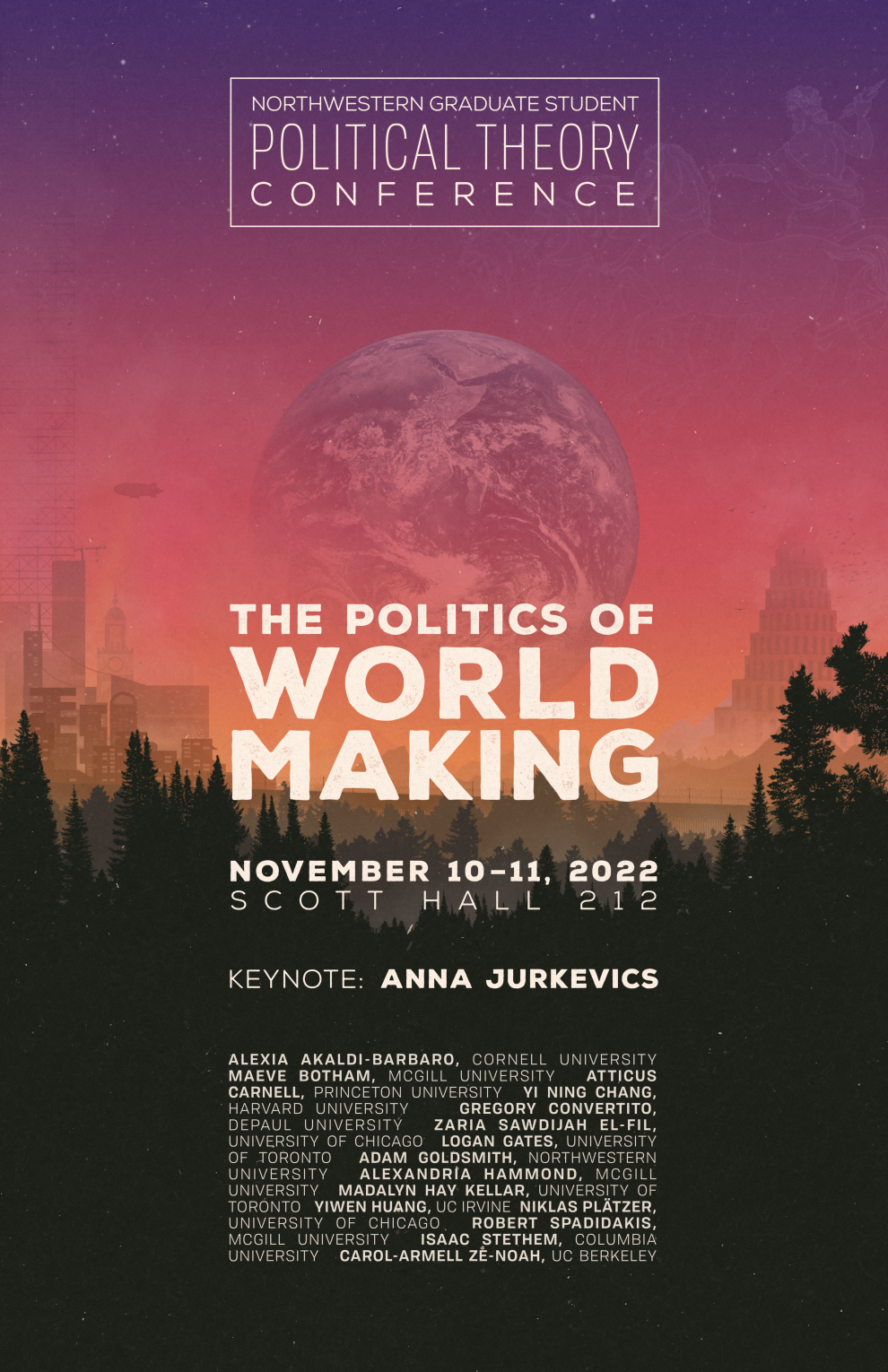
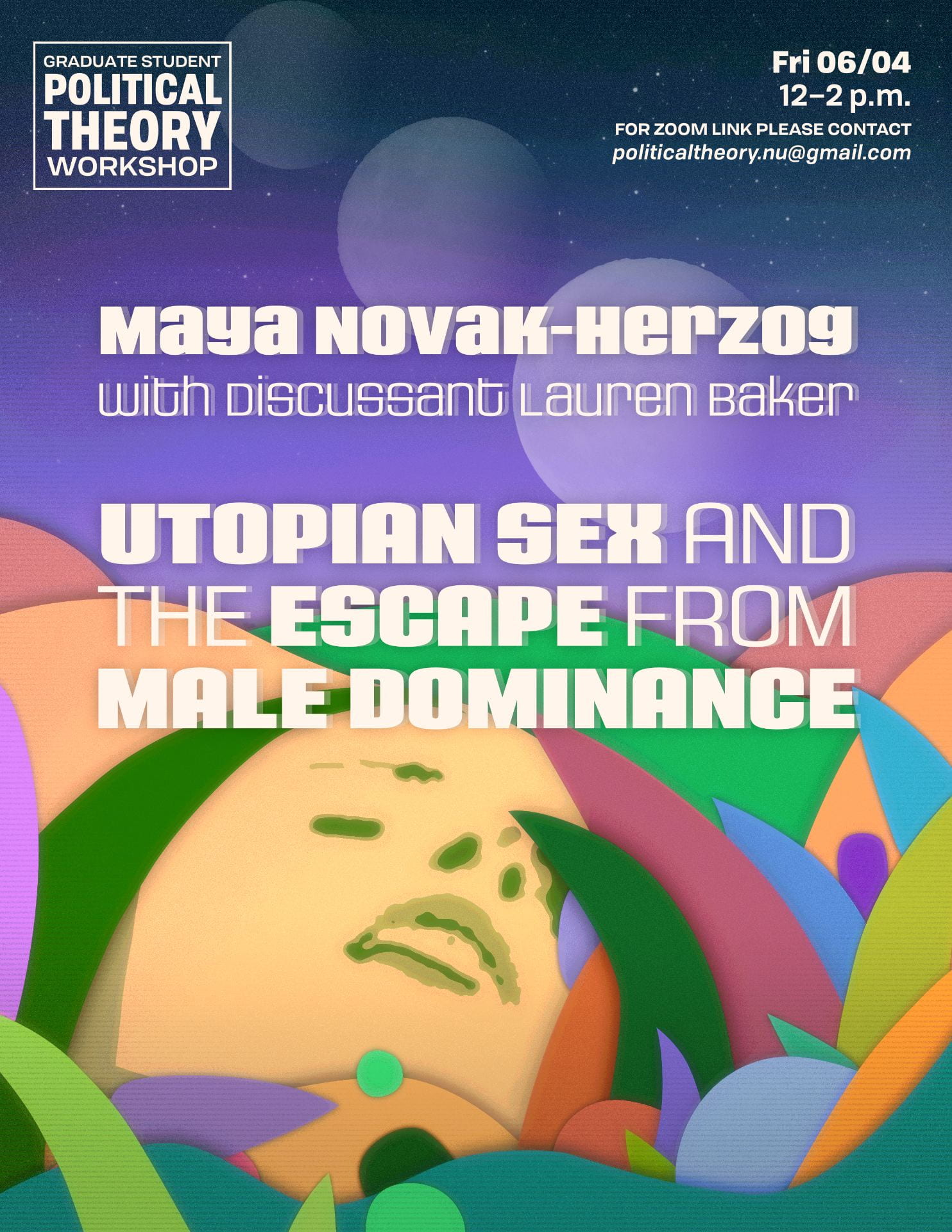
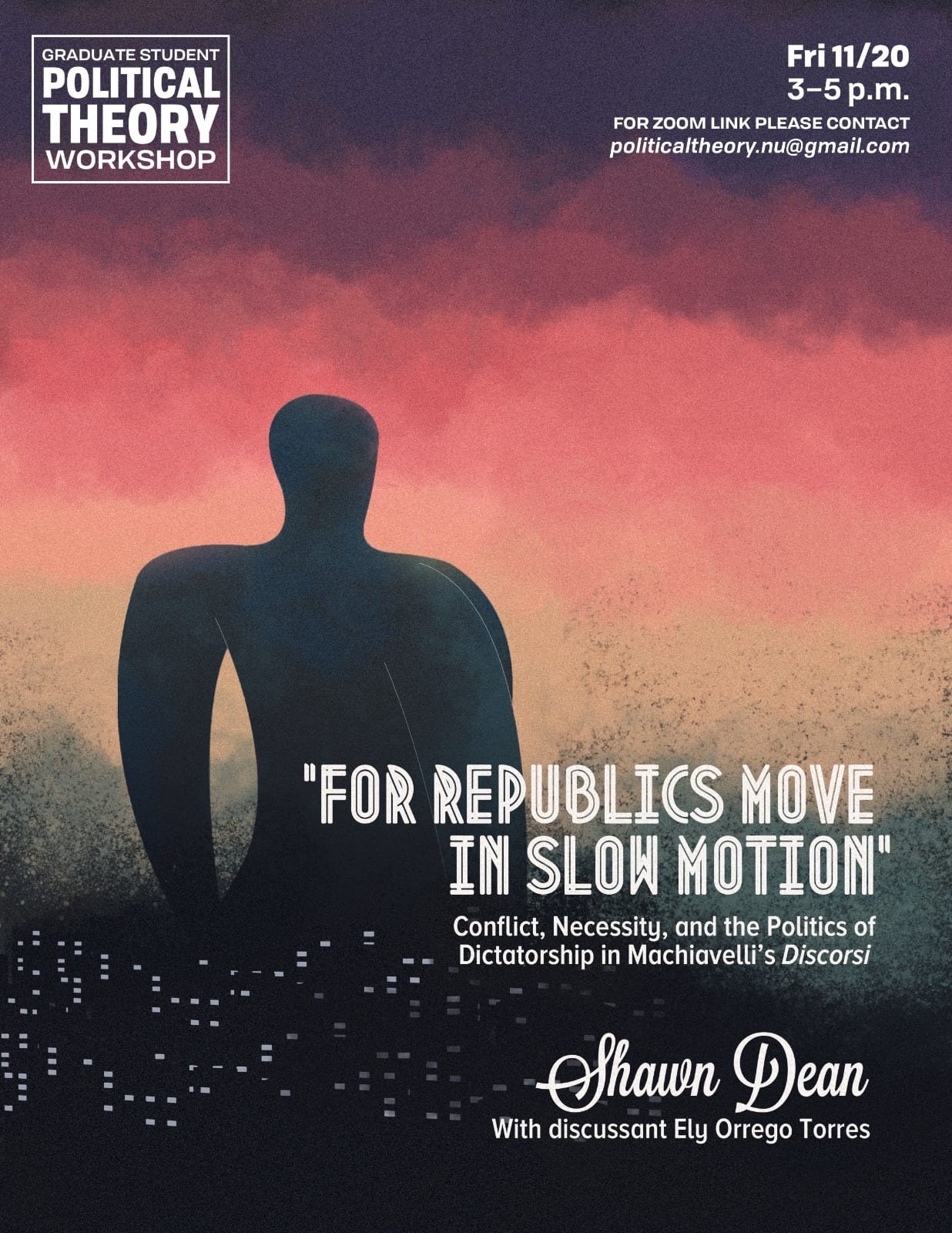
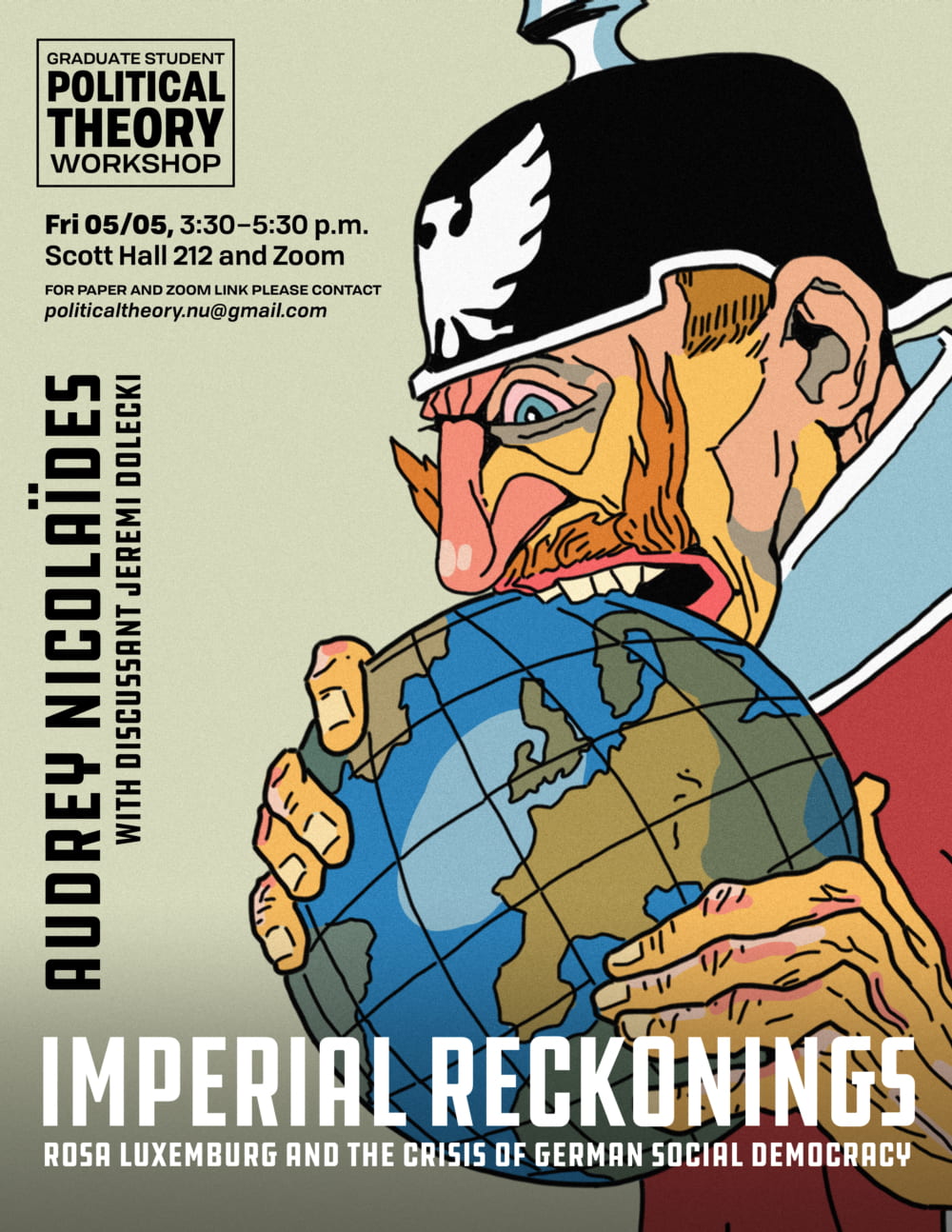
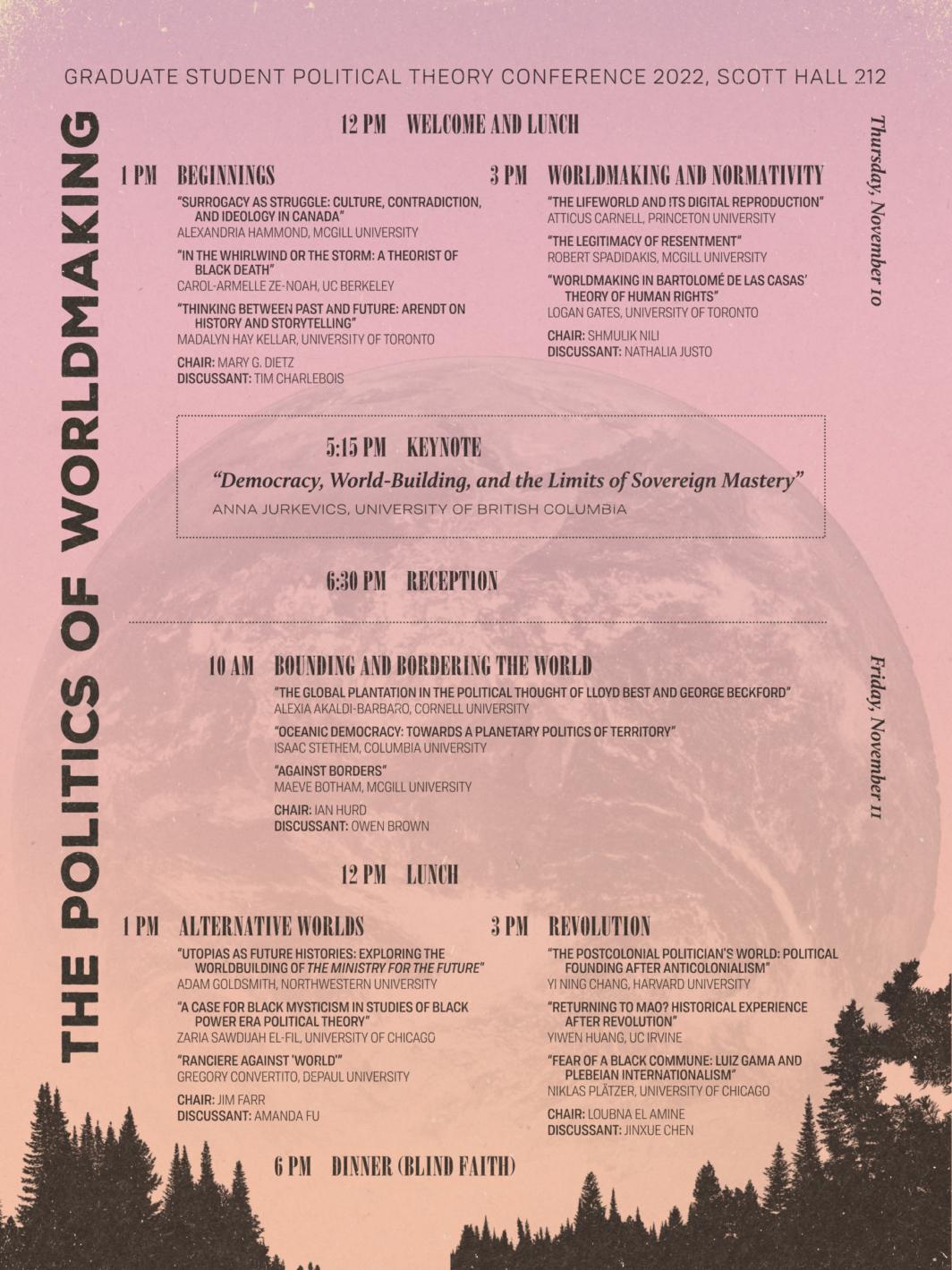
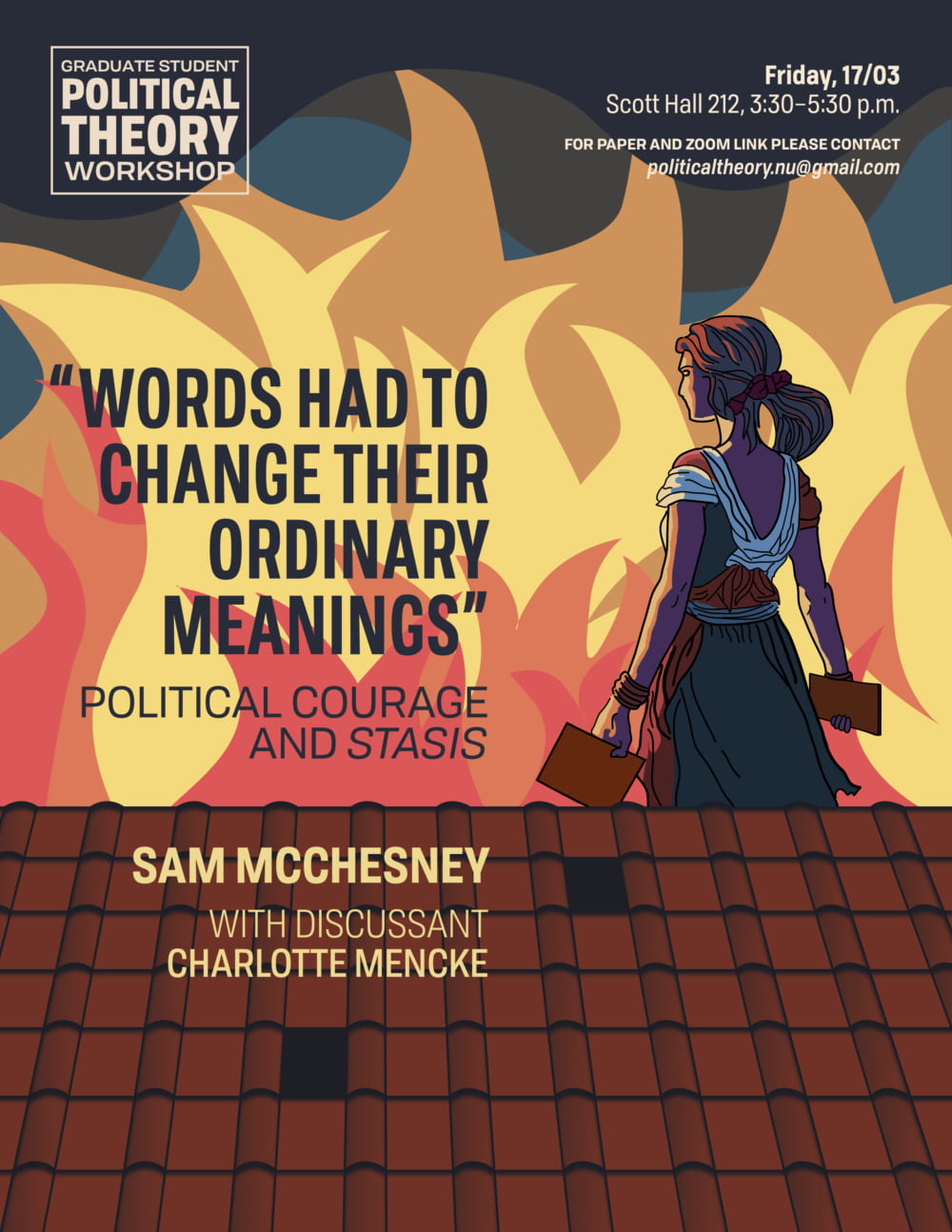
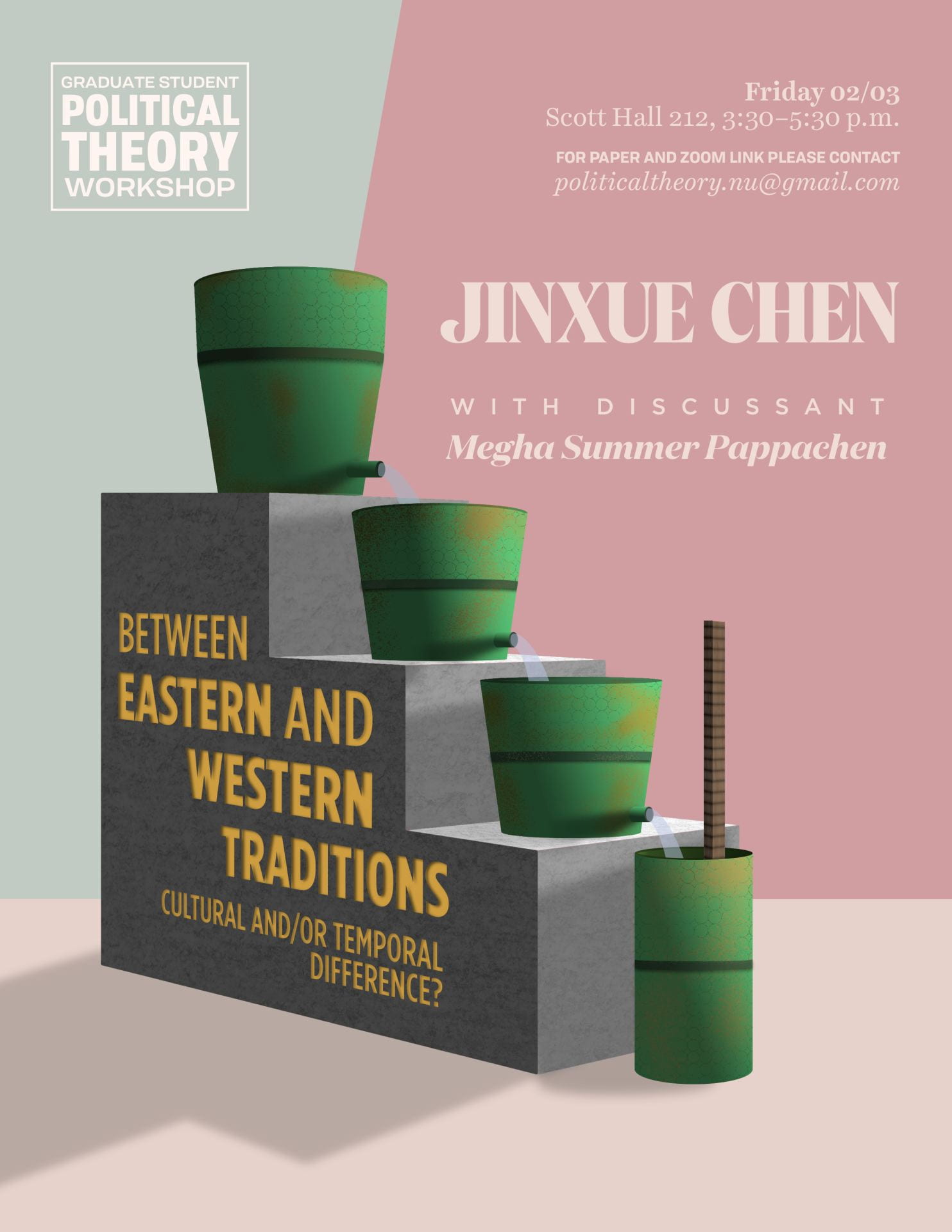
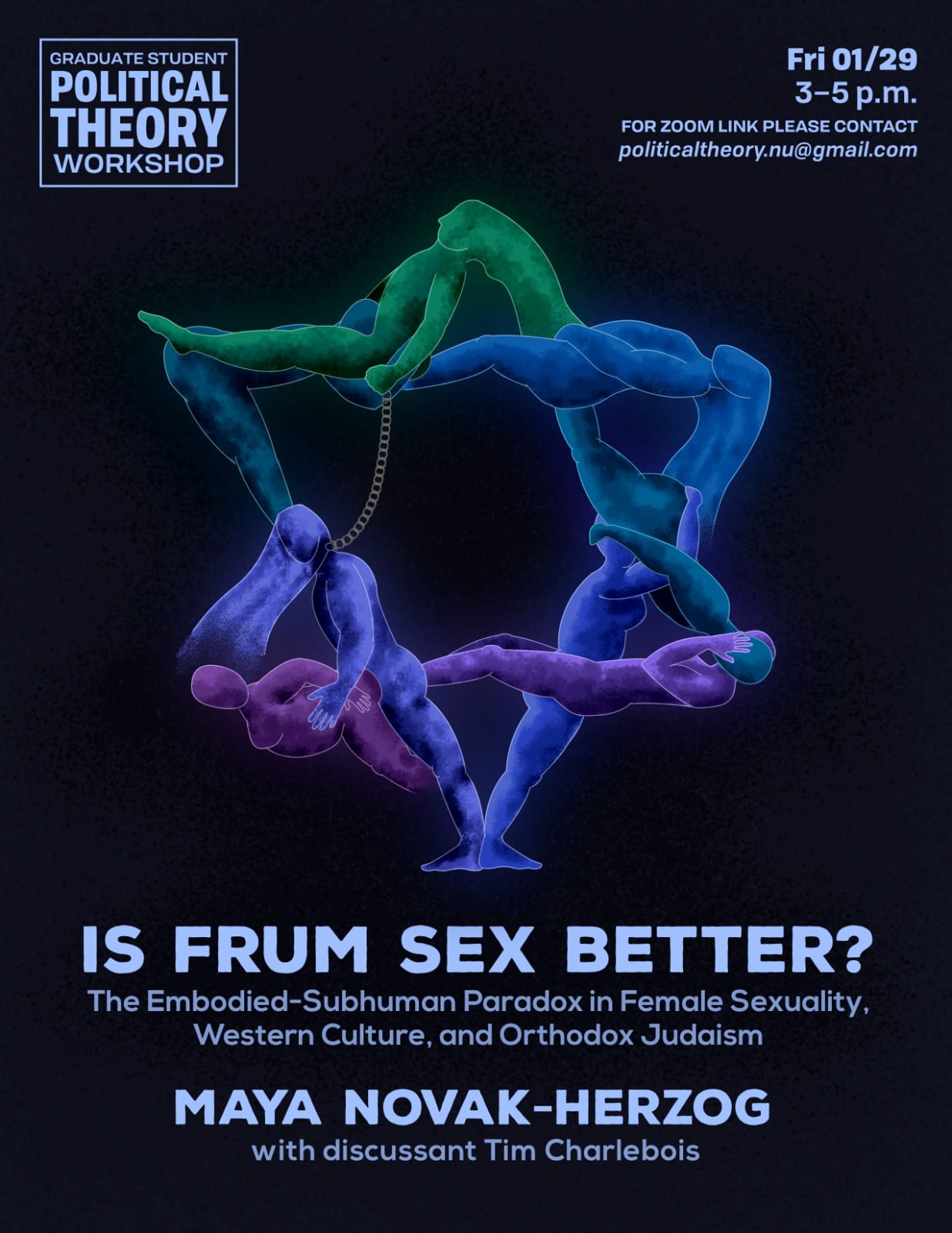
Posters designed for the Northwestern Graduate Student Political Theory Workshop. (Click to view.)

Copyright 2024. Image credit: Samantha Steinmetz.